Skip to content

Service · Web design

Portfolio website design

Show what you've done. And give people a reason to work with you.

Your work says a lot about your skill, your style, and the way you think. When it's presented well, it's easier for people to see what sets you apart and to picture a project you could do together.

Elad Oren

I build portfolio websites that bring together selected work, the context behind it, and a clear way to get in touch. I work with you from choosing what to show through to a site you can keep updating yourself.

  • Help choosing and organizing your work
  • Custom design
  • A site you can update yourself

Examples from my work

Every body of work
has its own way of being seen.

See the work

Architectural photography

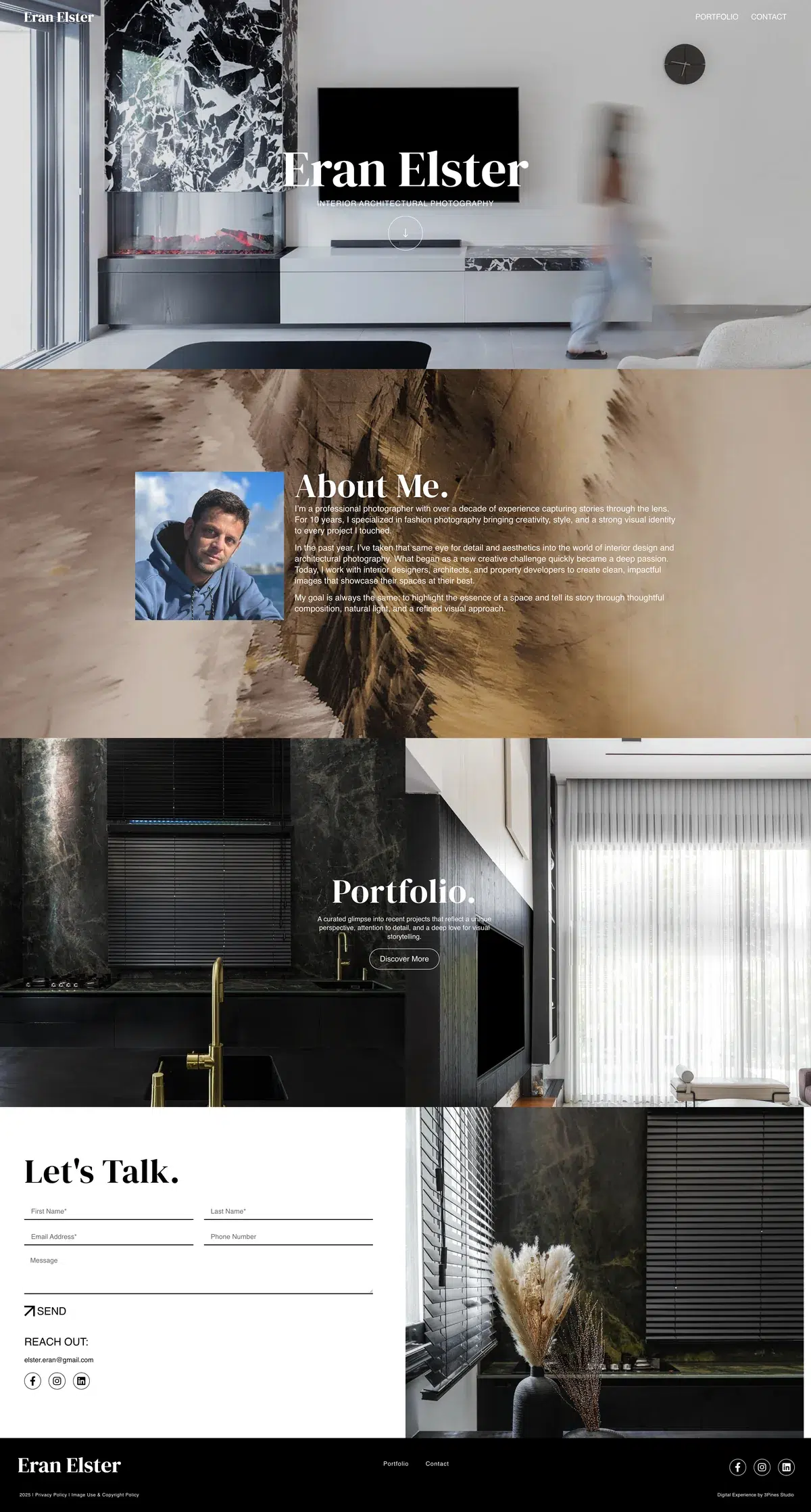
Eran Elster

A portfolio that organizes the photos by project and gives each space its own sequence. The galleries combine wide shots and details, in a restrained interface that keeps the focus on the photography.

View the Eran Elster project
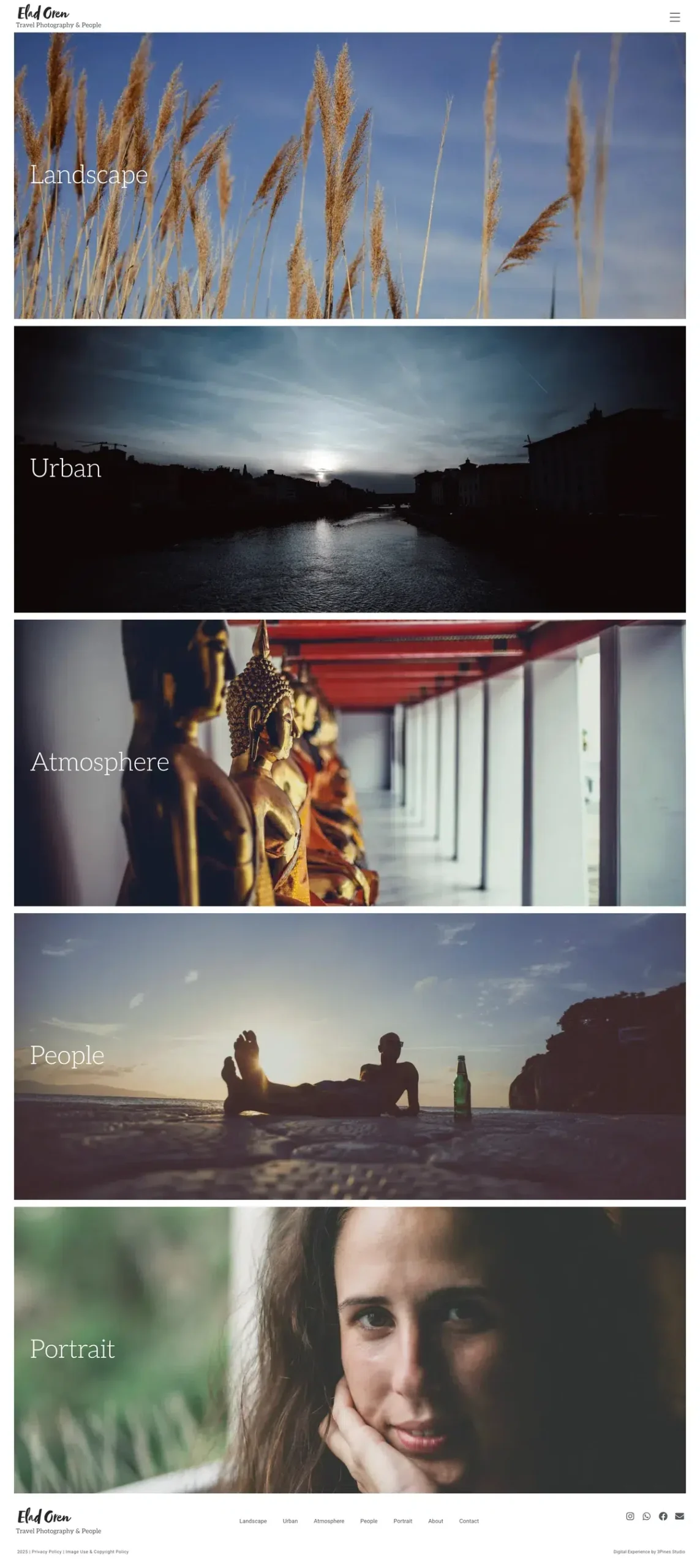
My own photography website

Elad Oren

Series on people, landscapes, and travel, grouped by type of photography. The site also reflects how I approach working with images: selection, order, and a viewing pace that suit the work.

View my photography project

What work would you want your next client to see?

Book an intro call

Who it's for

When your work is part of
why clients choose you.

The site starts with what you create and the people it needs to impress. Every field has its own materials and its own way of talking about the work.

  • Photographers

    Series, photography categories, and complete projects, with attention to aspect ratios, details, and the viewing sequence.

  • Graphic designers and design studios

    Branding, digital, and print, with room for the concept, the applications, and your role in the project. That way visitors can see the thinking behind the result too.

  • Architects and interior designers

    Projects that combine photography, plans, and renderings, with details on the type of space, the scope, and the people you worked with.

  • Developers and product people

    Products and interfaces, with an explanation of the problem, the solution, and what you were responsible for. You can include demos and links to a live site or published code.

  • Writers and editors

    Writing samples, publications, and editorial projects, organized by subject or type of work, with context on your role in each piece.

  • Content and video creators

    Films, campaigns, and digital content, with easy-to-use players, categories that make sense, and credits that make your part in the production clear.

  • Freelancers and consultants

    Case studies that show what you did, who it was for, and how you approached the challenge. You can show expertise and process even without a big image gallery.

If the site is mainly about explaining your business and services, a business website may be worth considering too. On the intro call, we'll decide how much room to give your work, your content, and your story.

What you get

From the work you have
to a portfolio that shows who you are.

  • Selecting and organizing your work

    We'll decide together what represents you today and what kind of work you want to get more of. Then we'll set an order and categories that help visitors find relevant examples.

  • Galleries that suit your material

    I'll plan the display around the type of media, the aspect ratios, and the amount of content. We'll decide whether you need click-to-enlarge, filtering, or search, based on how people will use the site.

  • A structure for project pages

    Each page pairs the visuals or a work sample with a short description, your role, and the key details. From there, visitors have a clear way to move on to another project or get in touch.

  • Room for the person and the service behind the work

    Home, About, Services, and Contact pages, as needed. You can add articles or updates when you have content that calls for them.

  • Images and media sized for the screen

    I'll prepare the files for the web and check sizes, crops, and load times on mobile and desktop. I'll pay attention to image quality, readable text, and accessible navigation in the galleries.

  • A system for adding your next project

    Content management in WordPress, with a set structure for projects and a walkthrough. You'll be able to add the images, text, and details of a new project and assign it to the right category.

The scope is set in advance: page types, the amount of material to add to the site, writing and editing, languages, and third-party integrations. The SEO foundation and inquiry tracking are planned along with the site. A store, private client galleries, or special features are scoped and priced separately if you need them.

How to present a project

A portfolio that shows
why clients should choose you.

A good image can spark interest. The information around it tells viewers what they're looking at, what you did, and why this work is relevant to them.

  1. Open with the work itself

    An image, a video, or a sample that introduces the project and invites a closer look.

  2. Give the context

    Who the work was for, what they needed, and what your part was. Credit collaborators where appropriate.

  3. Show what matters

    Details, process, or applications that help explain the work. If you have documented results, include them alongside the explanation.

  4. Offer a next step

    A related project, a related service, or an invitation to talk about similar work. Visitors can always get in touch, even from inside the portfolio.

Every field calls for a different level of detail. Sometimes a series of images and a few lines are enough, and sometimes it's worth explaining the process. We'll decide together how much is right for your work and your audience.

Working together

I know what it's like
behind the camera.

Elad Oren

I'm Elad Oren. I came to web design with a background in photography too, so I know how hard it can be to decide which pieces to include, how to order them, and what to leave out. I combine that perspective with business sense, design, and the technical side of the site.

Throughout the project you work directly with me, and you get a weekly update on progress and what's next.

A bit about me and the studio
  1. Discovery and direction

    We work out who the site needs to impress, what you want to show, and what materials you already have.

  2. Work selection and content structure

    We organize the projects, define categories, and decide what information should appear alongside each piece.

  3. Design with your own material

    We look at how the visual language works with your actual images, text, and video, on mobile too. You approve the direction before I move on to the build.

  4. Build, testing, and walkthrough

    I build the site and add the material we agreed on. I test the galleries, links, forms, and performance, and walk you through updating your work.

Before the call

Pull together a few representative pieces, a link to your current site or profile, and an idea of the kind of projects you'd like to take on. We can start even if your portfolio isn't organized yet.

Testimonials

On presenting the work
and working together.

From day one it was clear that Elad from 3Pines Studio understands photographers. He took the style and character of my photography and built a website that presents the work in a clean, smart, and inviting way.
Eran Elster
Architectural photographer
Excerpt from the testimonial
The process included several meetings where we went over and mapped out everything that was needed, and the final result was excellent.
Omri Rosenberg, Attorney
Rosenberg & Co.
On working with the studio · Excerpt from the testimonial
Listening, professionalism, and attention to detail, exactly what we were looking for.
Oded Hefer
Artender
On working with the studio · Excerpt from the testimonial

Questions and answers

Questions
before we start.

How many projects do I need to get started?

There's no set number. It's better to start with a selection that represents your direction and presents well. During discovery, we'll check whether there's enough material for the kind of site we're planning, and what's worth adding now or leaving for later.

Why do I need a website if I have Instagram or a professional profile?

A website lets you present a body of work in the order you choose, with project pages, information about your services, and a way to get in touch. You can link to it from social media and keep using those channels for exposure and for staying in touch with your audience. Each has its place in the bigger picture.

What if I'm missing images or don't have text for every project?

We'll go through your materials together and identify what's missing. Editing, writing, or photography can be added as needed, in a separate proposal. Even when the work is design, code, or writing, we'll find an honest way to illustrate it without crediting you with material you didn't create.

What determines the cost and the timeline?

The number and types of pages, the number of projects to add, how ready your materials are, the languages, and the features you need. The timeline also depends on feedback and approvals. After the intro call, you'll get a proposal with the scope of work, who is responsible for what, and a plan for the stages, including any related costs.

How do you make an image-heavy site work for Google?

I build the site with clear pages, content that gives the work context, image descriptions, and links between pages. I also take care of media file sizes and site performance. The service includes an SEO foundation as part of the build. For ongoing SEO, I can refer you to an SEO specialist if you need one.

Can I stop people from copying my work?

There's no way to fully prevent people from copying content that's shown online. You can upload versions meant for display only, add a credit, and consider a watermark where it makes sense. Disabling right-click isn't full protection. Confidential material needs a separate decision about how it's shared.

Can I add a store, video, or private client galleries?

Yes. We can look at adding video, selling your work, or an area for sharing files with clients. These are different needs: public viewing, client delivery, and purchasing each call for a different solution. We'll define what's needed and check the integration, costs, and licenses before including them in the proposal.

What happens after the site goes live?

At handoff, you get access and a walkthrough on managing your content. The proposal settles the domain, hosting, and licenses, and you can add maintenance and support. Adding new work uses the structure we built. Changing that structure or adding a new feature may require additional work.

Can you redesign my portfolio without redoing the content?

Yes. I start by reviewing the work, categories, and materials you already have. I map the URLs and content worth keeping, and use search data when I have access to it. If URLs change, I plan redirects. Changing a site calls for testing and monitoring, and I can't promise that every existing ranking will hold.

Intro call

Let's look at your work.

Then we'll figure out the right way to present it. Tell me what you create, who your audience is, and how you'd like the site to present you. Together we'll look at what you already have and what it takes to move forward.

A small studio. On purpose.

Leave your name and a phone number or email, and I'll get back to you. We'll go over the details on a call.

Contact details

A phone number or an email is enough. You don't need both.

How can I help? (optional, choose as many as you like)

I'll only use your details to get back to you. Privacy policy